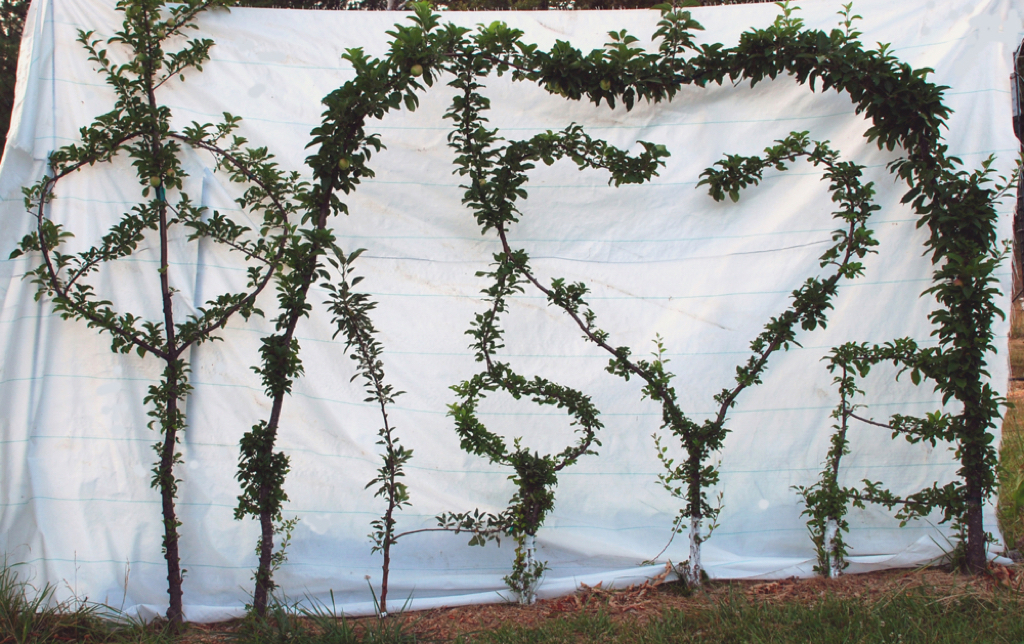
Sunday, January 24, 2010
Friday, November 27, 2009
Some correct planting procedures for trees, by Dr. Alex Shigo
1. Select healthy trees. Do not buy or plant trees that have roots crushed or crowded in a bag or container.
2. Plant properly. Do not plant too deep.
3. Plant the right tree in the right place. Do not plant large-maturing trees near buildings or power lines.
1. Select healthy trees
Money is wasted when you buy or plant trees that have roots crowded or crushed in bags or containers. Check roots before you buy or plant. If only a few roots are crushed, remove them with a sharp cut.
2. Plant properly
DO:
Plant at the depth where roots spread from the trunk. Prepare a planting site, not just a hole in the ground. Loosen the soil far beyond the drip line of the tree. Brace the tree only if it will not remain upright in a moderate wind. If necessary, brace only with broad, belt-like materials that won't injure the bark. Mulch away from the trunk with composted material (mulch should not touch trunk). Keep soil moist, not water-logged, to the depth of the roots. Remove dead and dying branches. Wait until the second growing season to begin training cuts for shaping and to begin fertilizing.
DO NOT:
Do not plant to deep. Do not bury roots in small deep holes. Do not wrap trees. Do not amend the soil, unless the soil is very poor. Do not brace the tree so tightly that the tree cannot sway. Do not brace with wire in a hose. Do not fertilize at planting time. Do not plant grass or flowers near the tree. Do not remove branches to balance crown with roots.
3. Plant the right tree in the right place
DO NOT plant large-maturing trees near buildings or power lines. Money is wasted when trees are topped or mutilated later. If a tree must be planted near power lines, plant only dwarf or low, compact species or varieties. Talk to knowledgeable people about the many choices you have for trees that have mature shapes and sizes that will fit your planting site.
About the Author
Dr. Alex L. Shigo is considered by many to be one of the foremost authorities on trees in the world. Shigo Died in 2006. obit http://www.shigoandtrees.com/index.php?_a=viewDoc&docId=5
Tuesday, November 10, 2009
Mark Primack's new web site

Mark Primack, Architect Santa Cruze
Friday, September 25, 2009
Take a class, have fun for a whole week !
Thursday, September 3, 2009
Wednesday, August 26, 2009
Arbo-architects - Tower Made Of Living Trees

Research Group Baubotanik at the Institute of Theory of Modern Architecture and Design (University of Stuttgart)
Sunday, August 16, 2009
Friday, August 14, 2009
Elephant hides in tree !
Tuesday, August 11, 2009
In the depths of northeastern India, in one of the wettest places on earth, bridges aren't built - they're grown.Wednesday, August 5, 2009
Herman Block donates 2 living chairs

Tuesday, July 28, 2009
Tree Shapers
Wednesday, July 22, 2009

Three young German architects are designing structures made completely out of living trees, including a pavilion for concerts in downtown Stuttgart. But designing the ultimate treehouse turns out to be trickier than one might expect. see the photo gallery! more...
Saturday, May 16, 2009
Ficus house- Okinawa
In Bio park on the island of Okinawa, Japan, this Ficus shelter is the worlds best (a far as I know) example of a intentionally grown living house. A real living tree house.Friday, May 8, 2009
Native Americans
It has been thought that Native Americans bent trees into shapes that pointed to something important to them at the time – water, cave, stream crossing, boundary, etc., and that the early settlers for at least some time, continued the practice. Here are a few photos of that type of tree manipulation.
Others say that the Native Americans never did this, and that these trees are only an oddity of Nature.
Steve Chyrchel, Interpretive Naturalist
Friday, February 27, 2009
Creations by Nature

It is what we call a black gum or toothbrush tree (Black Tupelo, Nyssa Slyvatica in the book). It is on the higher terrace of the Savannah River Swamp in Aiken County, South Carolina, near Silver Bluff, a site visited by Hernando De Soto about 1580. It appears to be two 10-12 inch forks from a single trunk of about 20 inches in diameter. The fork is about 2 feet above ground and the two branches reconnect perfectly about 8 feet above the fork to form a single trunk again of about 18 inches. The tree looks normal and healthy above the reconnection. This photo was recently taken in winter and no leaves were on the tree.
Sunday, February 22, 2009
Wizard with pipe
Thursday, January 29, 2009
Monday, January 26, 2009
Monday, January 5, 2009
just a small blue dot
Sunday, December 28, 2008
New on the web- From the Book
Arborsculpture- Solutions for a Small Planet on my web site.
See Axel Erlandson's Tree Circus and John Krubsack's Chair that Lived.
Like Erlandson, now John Krubsack has his own Wikipedia Page.
Sunday, December 7, 2008
Arborsculpture on e-bay

Saturday, December 6, 2008
Wednesday, November 26, 2008
J.C. Campbell

Sunday, September 28, 2008
The Gossamer Engine
The Gossamer Engine THE LITTLE ENGINE THAT WOOD
Bob Wulkowicz has started a tree talk forum "The Gossamer Engine" He presents new ways of thinking about trees.
Bob' Bio http://users.rcn.com/bobw.enteract/bobswebbio.html
Sunday, September 7, 2008
Living plant constructions- Germany
http://www.bio-pro.de/en/region/freiburg/magazin/03899/index.html
Tuesday, August 12, 2008
http://www.nytimes.com/2008/08/12/science/12prof.html?th&emc=th
Wednesday, August 6, 2008
Attack of the Sap Sucker

Saturday, May 31, 2008
Thigmomorphogenesis

I did not make up that word thank god ! Whoever did should be punished.


Tuesday, May 27, 2008
Nipple extension

Nipple extension.
In the life of every facet (encased inside a living tree) there come a time, every few years when an extension needs to be added.
The first photo is from 1996. The second is from 1999 just after the first nipple extension.
The last two were taken this week showing before and after the extension.
Monday, April 28, 2008
David Nash
Nearly 30 years later, the work is now taking on the domed form that he had planned for and intended when he first began: David Nash's Ash Dome.
Photo from 2004
From Cornell University a web page on Tree Sculpture.
Saturday, April 19, 2008
Cathedral Grove

Monday, March 31, 2008
Time lapse project

Sunday, March 23, 2008
Thursday, March 13, 2008
Medicine for a too fast life
The entry price to practicing this art is to check your speed at the garden gate and enter the slow motion world of tree time. A place where your own
thoughts are as loud as the wind in the leaves. Where the tortoise nature of the trees creeps up from behind and beats the hell out of your hare nature. But its all in good sport and the lessons are invaluable.
Monday, February 25, 2008
Kansas City Garden Symposium
Monday, February 18, 2008
Book Review- The Wild Trees
Saturday, February 2, 2008
Tree talk

I have been thinking about how trees talk. I think that it’s probably not so much that that trees talk but some tuned in people can listen. Trees are nature’s perfect antennas. I mean just look at their shape a double ended antenna one end spread deep in the earth the other end spread into the sky.
I believe it's just a matter of tuning in to these antennas to hear just what you need to hear. What do you think ?
Why are there trees I never walk under but large and melodious thoughts descend upon me?- Walt Whitman, Song of the Open Road
Thursday, December 27, 2007
Ivan Hicks and his Tree Tricks
This hardbound color book 116 pages out of England gets the "Thumbs up" "Bravo Bravo!"
I have just finished reading it and recommend it as the latest contribution to the field. This book titled "Tricks with Trees" by Ivan Hicks and Richard Rosenfeld takes a wide angle look at using trees in many different ways in landscape or garden settings. There are soft and hard styles in arborsculpture, the authors describe many of the simpler softer arborsculpture project ideas using drawings and photos. The writing style is not the typical dry English garden book at all it's almost witty with lots of attempts at humor.
I admit feeling some trepidation after providing the authors with the best of my photo collection. His treatment of my photos and his text overall was fair enough and I'm happy to have this book in my library.
Sunday, December 16, 2007
Harvesting the boat


Sunday, November 25, 2007
Plantware donation

Plantware has donated one of it's prototypes - the living bench to the children's playground in the "Shiba" hospital complex in Tel-Aviv.
Here are some pics from the installation and the donation ceremony http://www.flickr.com/photos/21066141@N04/sets/
I recommend watching the slideshow (the interesting pictures of the bench itself are at the end).
Please note some technical comments - the bench was donated with the temporary template which will be removed when the roots holding up the seat have become thick enough and strong enough. The seat is the only deadwood part of the bench that will remain embedded permanently. The bench was designed with this in mind. It was planted in Revivim a year ago.
Saturday, November 17, 2007
New content on my web site
Check it out and let me know what you think.
Richard
Monday, October 1, 2007
Very Large Topiary
Thursday, September 6, 2007
Friday, August 17, 2007
The China Connection
This raises several questions that I'm hoping someone can answer for me.
How common is this design ? Are there other designs ?
How common is arborsculpture in china ?
Is there a name for it ?
What species, if any, other than Ficus is used ?
Monday, August 13, 2007
dg03 arborsculpture on Flickr - Photo Sharing!
By Matt Kirkland
www.mattkirkland.com
"There are literally hundreds more like it lining the main streets in Ho Jie Town, Dongguan City, Guangdong Province."
Tuesday, July 24, 2007
Sunday, July 22, 2007
Sunday, July 15, 2007
50 year old lattice in germany by Neulohe.

From-Monday, June 25, 2007
Willa, The Living Chair

The living chair is a volunteer project. The volunteers have worked over the last year to construct a chair from live willow trees.
Friday, June 8, 2007
Thursday, June 7, 2007
Lebende Bauwerke or Living Buildings
Konstantin now owns http://www.arborsculpture.de/
Monday, June 4, 2007
Thursday, May 31, 2007
Tree Pressure


Tree PressureAbout 8 years ago when my daughter was 6, I was informed that I needed to construct a tree house.
A suitable grove of trees near our house seamed to be the perfect spot. Armed with some scrap wood a hammer and some nails I threw myself into the task. I know, I know, mom always told me "don't hammer nails into trees" but that was before Dr. Alex Shigo discovered the CODIT response. CODIT stands for "compartmentalization of decay in trees". Trees will produce a chemical barrier to stop the spread of decay. That is why inert items that enter a tree are easily dealt with and seldom pose a problem to a healthy tree.
I simply nailed short pieces of 2x4 onto the trees to hold the poles that were the frame for the floor. Now the trees of course continued to grow.
According to one study, tree roots will generate about 75 pounds per square inch. I am assuming that trunks also generate this kind of pressure. The photo illustrates how the 2x4 is being pushed away while the nails are held in place resulting in a situation where eventually the 2x4 will be pushed out while the nails are pulled through. Notice how deep the nail heads are.
Richard
Wednesday, May 30, 2007
Growing a Hidden Architecture - Christian Kerrigan
Sunday, May 20, 2007
Saturday, May 5, 2007
Ron Lanner- dedicated tree guy
This site is devoted to trees. Among naturalists, biologists, environmentalists, and others trees get lots of lip service but mighty little respect. Everybody admits to liking trees, but few bother to really learn much about them -- and true respect demands a reasonable level of knowledge. Why is this?
Tuesday, May 1, 2007
Maximum possible tree height 130m ?
Research on tree height limits and reasons why trees grow faster when younger.
Monday, April 30, 2007
Wikipedia
Sunday, April 22, 2007
Living Architecture

Tree Sculpting & Living Architecture
Throughout history, humans have sought to live closer to nature and seek a balance between dwellings and the trees they are built near. In fantasy and reality this desire has been accomplished in a wide variety of forms. In this work, we explore the shaping of a tree's trunk and branches to create a 'shell.' Over this is laid mosses and soils, into which the tree may send out roots. These roots will stabilize the soil from erosion, recontouring the landscape and creating an interior space which may be finished to suit the structures use. In this way, buildings and dwellings can be formed.These structures blend gracefully with their environment, as the threshold may be pronounced or subtle. The plan of these dwellings is not to replace something on the land, it is to effect a synthesis of elements that formulate a Living Environment.
Tuesday, April 17, 2007

Thursday, March 22, 2007

If you were thinking that the Banyan tree looks like the trees whose roots snake through the ruins of the Ta Prohm temple like tentacles of the jungle (Lara Croft, anyone?) at Ankor, Cambodia , you’d be right!
Banyan tree (or is it silk-cotton tree?) in the ruins of Ta Prohm, Ankor, Cambodia (Image Credit: Casual Chin [flickr])
Saturday, March 10, 2007
Espalier pro in tennessee

http://www.espaliertrees.com/rrf.html
I was honored to meet Peter Thevenot at my lecture in Nashville.
House plants ?
see the PDF http://www.jdf.or.jp/eng/compe/pdf2005/816-e.pdf
Tuesday, March 6, 2007
from your table comes food for your trees

The human plays an important part at the table by eating, feeding the food waste to the worms, feeding the resulting fertilizer to the plants, or by simply sitting and appreciating the living ecosystem she/he is a part of. A cross-section of the activity inside the top 9 inches of the compost is made visible using an infrared security camera connected to an LCD screen built into the table. On the screen, viewers can see the live movements of the worms and sowbugs inside. http://accad.osu.edu/~ayoungs/digestive.html